This article was written in 2025, right after the release of the video below, but was never published. To launch this blog and celebrate the release of his new album Nautilus, I decided it was finally time to make these thoughts public.
FIRST OF ALL, A BETTE? DISCLAIMER:
That Pier Piras is a virtuoso on his instrument and a great composer is beyond debate and if you don’t know him yet, CHECK HIM OUT HERE.
That his super-brave album “Eolo”, made of acoustic bass instrumentals and whispered, wordless lullaby melodies, is innovative, there is no doubt.
The issue is that for his solo album “Eolo” (2025), recorded at Roble Factory in Alghero, they chose to walk down, in my not-so-humble opinion, the path of engineering masochism.
And let me state this upfront as well: Antonio Leardi from Train to Roots is a musician and sound engineer with far more experience than I have, and I don’t want any of you readers to think I don’t recognize his professionalism…
BUT I WOULDN’T HAVE DONE IT LIKE THAT.
THE CHALLENGE
Recording an acoustic bass can make anyone lose their mind. An acoustic bass doesn’t really play; it whispers. It’s the musical equivalent of Keanu Reeves who talks without any vocal projection, making your sci-fi fan grandma yell: “Turn it up, I can’t hear a thing!”, only for the soundtrack to kick in two seconds later and have her scream: “Turn it down, it’s way too loud!”
Still, the signal chain orchestrated at Roble Factory introduces challenges I would have gladly spared myself.
THE FIVE-SIGNAL MADNESS
Let’s look at the room setup, in the sound engineer’s own words:
I chose two condenser mics and two dynamic mics.
With the two condensers, I want to capture the full sound of the bass, everything coming out of its body as well as the neck.
With the 87, literally “everything,” from the lowest frequencies to the highest ones.
With the AKG 451 B, still the whole bass, just a bit more defined: having a smaller capsule than the Neumann, we’ll get a more intelligible sound… […].
Meanwhile, with this 57, I want to capture the noises the left hand makes on the strings when they fret against the neck.
And this guy here: the SM7 […] we’ll use it for the percussive parts you play on the body of the bass; we’ll give it a specific EQ curve to bring that out.
~ Antonio from Roble Factory
- Shure SM57 (Dynamic): for the neck.
The microphone some call a desert island mic because you can use it for anything, including hammering tent pegs into the ground. Steve Albini, on the other hand, called it a “Piece of shit dynamic mic some people are inexplicably crazy about.” - Neumann U87 (Large-diaphragm FET condenser):
The “quality” mic to capture the voice of the instrument.
It’s the microphone equivalent of David Lynch. Nobody talks trash about it, even if they wanted to, especially at that price tag! - AKG 451 B (Small-diaphragm condenser):
to capture fast transients. Back in the ’70s, it was the go-to mic for disco hi-hats. Fun fact: AC/DC used to put a condom over it so they wouldn’t get the recording pregnant. - Shure SM7 (or SM7B?) (Dynamic):
to pick up the percussive syncopations on the body that Pier is a master of.
As the video mentions, it’s the mic of Michael Jackson, Metallica, and hundreds of radio stations, and it’s great if you want to isolate an instrument from the room.
Nowadays it’s used by YouTubers and OnlyFans sex workers, though it’s not very hygienic to lick it like they do with the 3Dio. - Telefunken D.I. Box:
for the direct signal from the instrument’s piezo pickup. It houses a smoky OEP/Carnhill transformer, wound directly in the fog (or perhaps out of the fog) of the United Kingdom.
It saturates gloriously on the low end thanks to its Nickel-Iron core. It excels at handling weak signals while keeping them crystal clear, though if you push it a bit harder, it has a lower saturation point than more linear transformers (to use a cooking oil analogy, it has a lower smoke point).
The catch is its input impedance of around 20kΩ: when it sees the megaohms of a naked passive piezo, it gets offended, brutally chops off all the low end, and turns your instrument into an intercom. Yet Pier Piras loves it. How is that possible?
Simple: he doesn’t send the passive piezo to die alone against the transformer without armor. The bass has an onboard Fishman preamp acting as the perfect middleman: it welcomes the piezo into a ~10MΩ input (saving all the low frequencies) and drops the output impedance down to around 1–2kΩ, ten times lower than the Telefunken’s 20kΩ. That turns the signal into a battering ram that smashes right through the gates of the Nickel-Iron core, pushing it into sweet saturation while keeping the frequency response completely intact.
The result? Warm apple pie…you know, the Jim Levenstein kind.
EXECUTION
Let’s bust a myth right away: the problem with this setup isn’t using lots of mics and little boxes on a single source. Anything goes, provided you take a few precautions.
The first acoustic somersault here is that the Shure SM57, the Neumann U87, and the AKG 451 B are placed practically touching each other, yet aligned h-o-r-i-z-o-n-t-a-l-l-y (meaning they are anything but coincident!).
The capsules capture the exact same wavefront, yet they do so with:
- different polar responses and internal phase shifts due to their angle relative to the source, capsule sizes, and completely different designs;
- off-axis side-lobe interference caused by the physical presence of the neighboring mics;
- completely different diaphragm compliance.
Doing this means you’re asking for pain at mixdown, where you’ll go head-to-head with your arch-nemesis: comb filtering.
🤓 Click here for the scientific definition of Comb Filtering
In acoustic physics and signal processing, comb filtering is an interference phenomenon that occurs when an acoustic signal is summed with a copy of itself delayed in time by a tiny amount .
The physical cause: time delay
When the two waves overlap, the time offset translates into a phase difference that varies as a function of frequency :
- Constructive Interference (Peaks): Occurs at all frequencies where the waves are in phase. At these points, the amplitude doubles.
- Destructive Interference (Nulls): Occurs at all frequencies where the waves are 180° out of phase, causing complete signal cancellation.
The transfer function
Mathematically, the frequency response of a comb filter (the sum of two equal-amplitude signals) is described by the transfer function:
The first theoretical total cancellation occurs at the fundamental frequency:
Subsequent nulls repeat cyclically at all odd multiples of this frequency:
When plotted on a linear frequency graph, the spectrum no longer looks smooth, but jagged with a geometric series of deep, razor-thin valleys.
It gets its name because, when printed on a chart, the peaks and dips look just like the teeth of a hair comb.
SO WHAT?
How our brain perceives delay over time ( )
Our brain interprets time offsets in completely different ways depending on the delay time:
-
Comb Filtering (from 0 to ~15 ms): when the delay is microscopic, the human ear doesn’t hear two separate sounds or a timing gap. The brain fuses the signals and perceives only a brutal, nasty, artificial tonal shift.
How to describe it? Hollow, metallic, like listening to music from inside a thin glass jug. -
Haas / Precedence Effect (from ~15 to ~40 ms): now we enter psychoacoustics. The brain still hears a single sound, but localizes the source exclusively toward whichever mic the sound hit first (the undelayed track).
The delayed signal isn’t heard as a separate event; it simply widens the perceived spread of the sound in the mix.
This is the trick used to create 3D headphone spaciousness in Dolby Atmos mixes, or that ULTRA-STEREO button on a ’90s basement boombox. -
Delay / Echo (above ~40–50 ms): once the delay crosses the ear’s temporal resolution threshold (the “Haas integration window”), the brain cleanly separates the two events.
Destructive cancellations and stereo-widening illusions stop happening: we clearly hear two distinct sounds—an original note followed by its repetition (a classic echo or delay).
It’s the sound of Elvis’s 1950s “slapback echo” vocals, or the guitar on Where the Streets Have No Name.
The 3:1 rule and vertical-axis geometry
If you decide to attempt coincident capsule placement to eliminate time delays, you ought to obey two golden rules of acoustic physics.
I say ought to because everyone is free to do whatever they want, though it helps to know the rules:
-
Avoid mixing wildly different microphone types:
A dynamic, a large-diaphragm FET condenser, and a small-diaphragm condenser have polar patterns, internal electrical phase shifts, and off-axis behaviors that are completely incompatible when crammed within a few inches of each other.
It’s like making a sandwich with prosciutto, smoked provolone, and Nutella. Great if you’ve got the munchies, just don’t complain when you get a stomachache later. -
Align on the vertical plane, not horizontal:
Since the sound source (the body and neck of the acoustic bass) runs horizontally, lining up microphones horizontally means each capsule picks up a different vibrating section of the instrument, maximizing comb filtering.
If you really insist on dirty mic pairings, at least stack them vertically, so they look along the same axis of the instrument. No Kapsulemasutra.
If you can’t, or won’t, do this vertical geometric alignment, your only remaining escape route is the classic 3:1 rule:
the distance between the second microphone and the source must be at least three times the distance between the first microphone and the instrument.
And what about the YouTuber mic?
That one was placed almost a meter (about three feet) away. Now you might tell me: “Well, maybe he followed the 3:1 rule… and besides, Michael Jackson used it too.”
Aside from the fact that I never bought that whole Wade and Safechuck story… just because Michael Jackson did something doesn’t mean you have to.
There’s a key difference: the voice of the biggest pop star of the ’80s doesn’t put out the same SPL in decibels as a Cort acoustic bass, even when played by someone who has dedicated his life to the instrument. It’s an intimate instrument, and the one thing you cannot do is point a dynamic mic at it from a meter away, unless your goal is to amplify self-noise, or as we call it in studio slang, “the HISS.”
THE JUNK IN THE BACKGROUND
Clearly Antonio was working solo, in a rush, hadn’t had his coffee, or his back was hurting, there could be a dozen completely valid reasons… still, he didn’t clear the room properly for the musician.
To Pier’s right, we see a piano, thankfully with the lid closed (throwing a heavy moving blanket over it would have helped even more). And behind him? A full drum kit set up, cymbals and all. For an acoustic session this intimate and fragile, I’m sure they at least disengaged the snare wires.
Why bother with all these precautions? Because of SYMPATHETIC RESONANCES, which show zero sympathy when they ruin your day at mixdown. Have you ever sneezed near an empty radiator in the middle of summer? Heard that ZIIINNNNNG? If yes, you’ve got what it takes to be a sound engineer.
THE PULTEC
A.K.A. THE SOUR CREAM OF RECORDING STUDIOS
«During mixing, we first created a bus for all the microphones […] and routed them to a stereo channel on the console. So we did an initial volume balance “in the box,” inside the computer, to shape this sound… and then brought it out here [points to the console]. We ran it through the console filter—just a touch of filtering—and most importantly, we ran it through the Pultec.
At this point, it sounds like watching one of those TV chefs going: “We took our mushrooms, diced them finely, deglazed them with our white wine, and then to give them even more character, we folded them into our sour cream.”
And he goes on:
The Pultec, for anyone who doesn’t know […] is an equalizer, maybe the first, or one of the very first equalizers ever used in music history […]. And it’s TUBE-DRIVEN.
What happens with tubes? Tubes, unlike FETs, which is what this console is made of [points to the mixer], tend to round off transients as well. So you really have to understand where to use them, because when you want sharp transients, like on a kick drum or an electric bass… or even an acoustic bass, for instance… I would never have used them while tracking, because they would have smoothed out the transients too much.
Instead, once we gave it the right amount of transient punch at the end of the mix, running it through there smoothed out the lows and highs a bit, making them much more, at least in my opinion, making them more palatable.
All true, spot on! Though at the word “amiable,” our TV chef suddenly turns into a fine-dining sommelier.
Actually, maybe they become more Hi-Fi, okay? Even though tubes are supposed to dirty things up, they somehow make it sound a bit more Hi-Fi.
In my opinion, they make it easier on the ear, especially those somewhat harsh upper-mid frequencies […] Passing through there smooths them out, because the Pultec basically does a counter-EQ: whatever it boosts also gets cut […] it gets attenuated right after and right before. And in fact, we then went back to recover those mids around 800 Hz—which the low-end cut had hollowed out a bit too much—right here on the console’s own EQ [points to the SSL]… we gave a little bit of that back.»
Here lies the technical contradiction that makes for great bar-stool debate: the Pultec’s tubes tend to round off and soften transients (the initial attack of a note).
On an acoustic instrument where the player is executing SLAP and POP, slamming the body percussively, and chasing the crisp detail of fingertips, knuckles, and nails, running the entire mix bus through a box that tames dynamic peaks feels – to me, at least – counterproductive.
Personally, I might have reached for parallel compression, though that’s a topic for another post.
To fix it and bring back the attack the Pultec was eating up, they had to get surgical on the console around 800 Hz, artificially boosting the midrange hollowed out by the low cut—and, more importantly, hollowed out by the comb filtering we discussed at length above.
A routing loop that’s perhaps indulgent, perhaps circular, and definitely worthy of Rube Goldberg.
SSL
THE “GLUE COMPRESSOR” AS A LIFESAVER
What saves this pile of tracks from theoretical collapse? The legendary Quad Bus Compressor built into the SSL 4000 E console.
Without getting bogged down in circuit schematics, the combination of its VCA (Voltage Controlled Amplifier) architecture paired with an input transformer imparts a subtle low-end saturation that many engineers find pleasing.
Used at the end of the chain to pull everything together (what engineers call glue), it acts as the frosting on a slightly burnt cake, neatly hiding the blemishes underneath.
WHAT IF I WAS WRONG?
Yeah, well… then you actually go listen to the album, and all this comb-filtering apocalypse is nowhere to be heard.
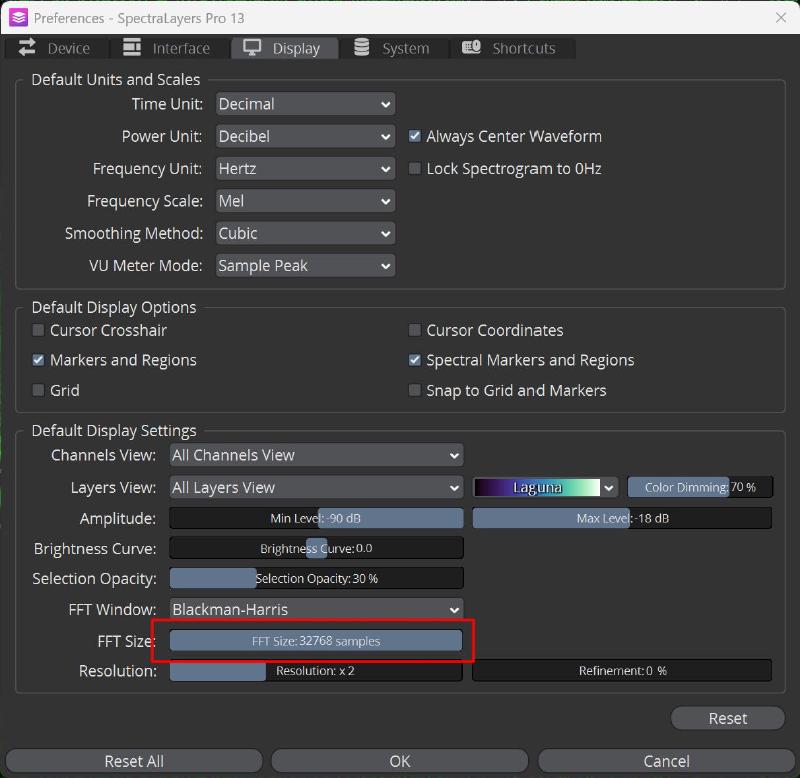
So let’s run a scientific test: let’s open a track in SpectraLayers. First, we crank the FFT size all the way up.
Next, we load the WAV file of a random track:
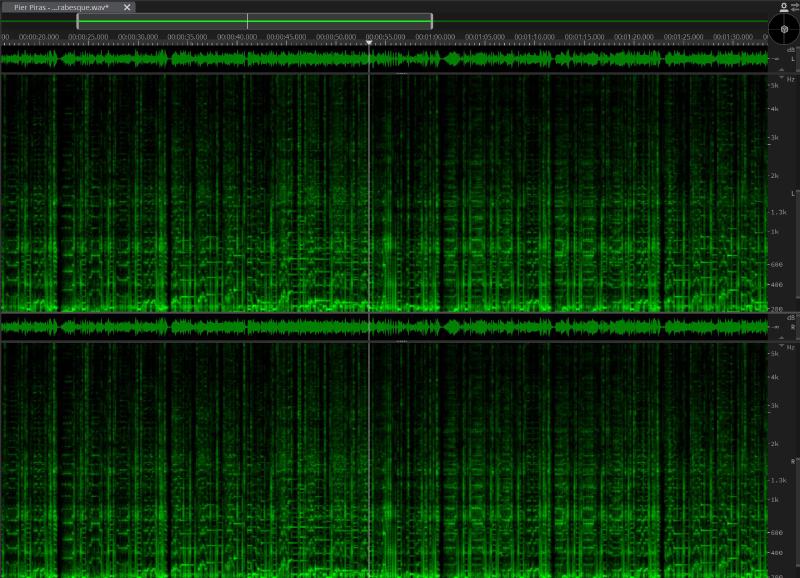
I’ll admit it: there’s no obvious comb filtering 🤔
Let’s zoom in:
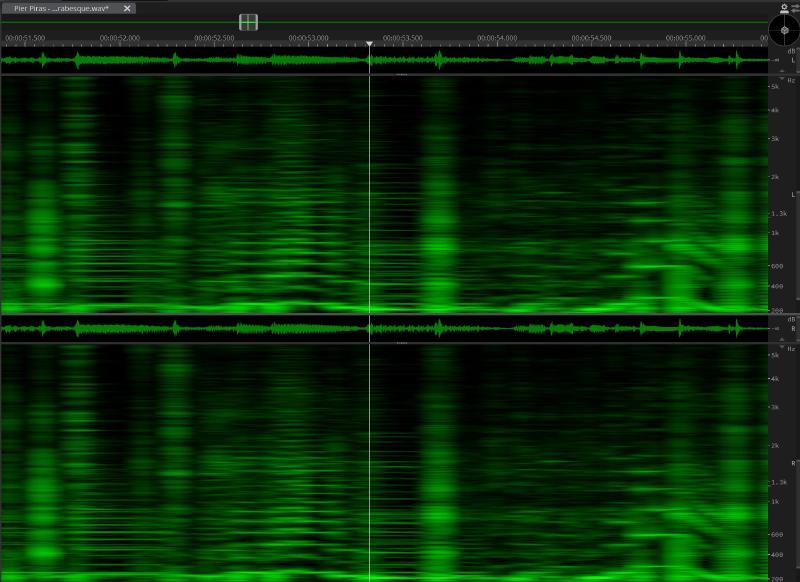
Nothing here either.
What should we have seen?
Great question: let’s simulate it with a Post Filter. We’ll simulate the visual effect using a parametric equalizer, inserting a series of evenly spaced notch filters to mimic comb-style cancellations… We won’t go overboard with the Q, that wouldn’t be realistic, but we’ll cut by 24 dB so it shows up clearly in SpectraLayers.
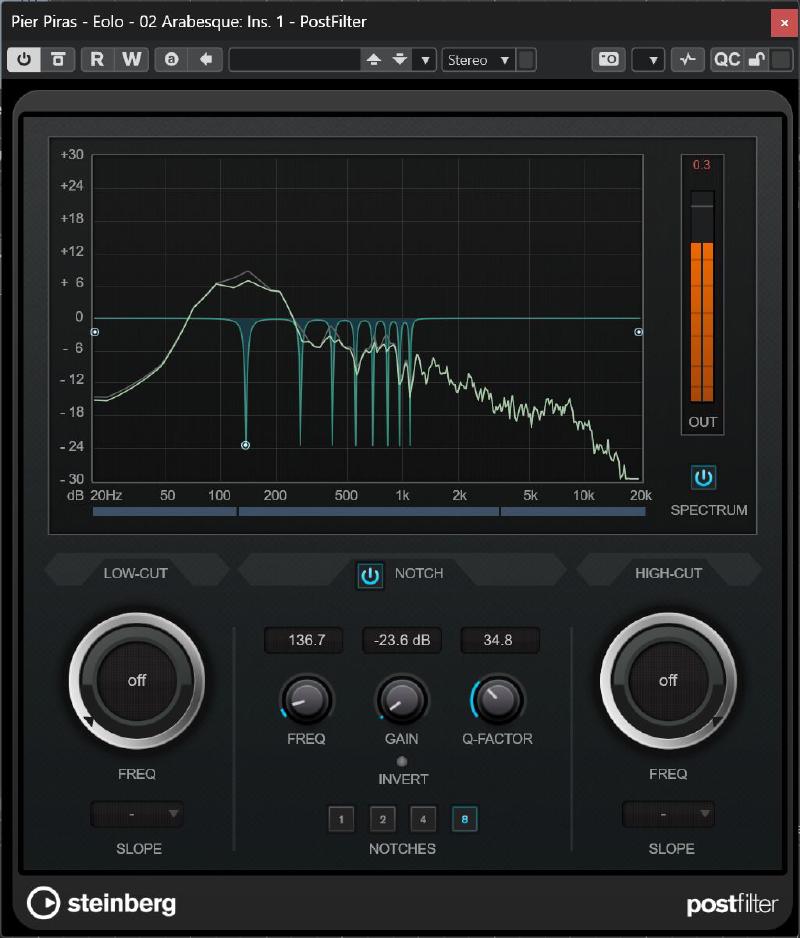
Now all that’s left is to reopen SpectraLayers and compare the result.
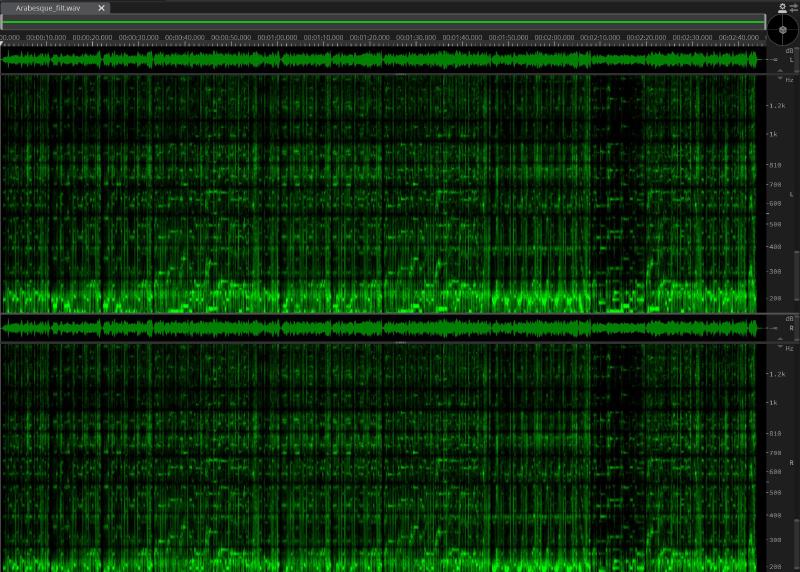
Now we’re talking, see those continuous black horizontal lines? Even as the notes change, there’s a permanent frequency hole carved right across the entire track. Comb filtering shows up as a series of empty black horizontal lines slicing through the audio stream from left to right. It’s the visual footprint of frequencies missing in action from the mix.
So you were wrong!
The record genuinely sounds great. And here I can only hazard a few guesses as to why:
- (Very likely) During mixdown, someone did obsessive micro-time-alignment of all the tracks inside the DAW.
- (Totally possible) Antonio set up the four mics like that for the promo video, then changed his mind after a couple of test listens.
- (Almost certainly) Antonio tracked all four mics, then when it came time to commit to the mix, muted or heavily pulled down three of them, leaving mostly the Neumann and/or the piezo channel up front.
- (Less likely, though that’s the magic of analog) The Pultec and SSL generated harmonics that weren’t in the raw tracks, filling in just enough frequency content to mask the comb notches.
AND WHAT ABOUT YOU, SMARTASS…
HOW WOULD YOU HAVE RECORDED IT?
It’s way too easy to nitpick someone else’s work from the comfort of your couch. So here is how I would have tackled the acoustic bass challenge, minimizing phase cancellations while bringing home a solid, easy-to-mix sound:
- A High-SPL lavalier attached near the bridge: cushioned against the wood with a small piece of soft foam to isolate it from mechanical body vibrations and secured with gaffa tape. A tiny condenser mic placed right near where the string is plucked gives you all the attack, body, and sub-end you need, with practically zero room bleed. An “organic, gluten-free” solution that sounds far more natural than a piezo.
- A Mid/Side (M/S) stereo microphone pair: placed at the sweet spot to capture the stereo image of the instrument. For the Mid and Side capsules, I’d use either two ultra-fast transient condensers like the sE Electronics T2 (with their super-stiff titanium diaphragms) or a stereo ribbon microphone. Contrary to popular myth, ribbon mics ARE NOT slow on transients (the mass of the aluminum ribbon is negligible, comparable to that of the air layer setting it in motion), yet their natural high-frequency roll-off makes them smooth and pleasant to the ear… even before hitting a Pultec! Then I’d do a blind A/B test and let the musician choose.
- A low-noise omnidirectional mic laid flat on the floor: Literally taped to the ground to capture the room, taking 100% advantage of the boundary effect to eliminate phase cancellations.
When an omni capsule sits flush against a hard surface, floor reflections don’t arrive late because there is zero physical distance between the capsule and the boundary: the direct wave and reflected wave sum into a single, coherent signal, handing you +6 dB of free gain and zero floor-induced comb filtering.
There—now you know the secret, and you’ll never need to buy a PZM mic in your life.
IN CONCLUSION
At the end of the day, “Eolo” delivers the goods; first and foremost because the performance is stellar, and Piras’s music, dynamics, and intent triumph over the madness of the setup; and second, because engineer Antonio Leardi, even when breaking “the rules,” knows his craft inside out and knows exactly where to reach to get a great result. Sure, there might be some imperceptible phase cancellation lurking between those mics, but a good engineer can immediately tell whether a problem is real or purely theoretical.
The question remains whether all that effort, analog consoles, and thousands of euros’ worth of microphones wasn’t just a gorgeous exercise in style, one that could have been solved with far less stress by applying a handful of rules that have stayed pretty much unchanged since the 1940s. I wholeheartedly recommend the album, and maximum respect to Roble Factory, above all because they’re skilled people who genuinely love music.
Still, the fact remains: applying four basic acoustic principles makes your life a whole lot easier!